
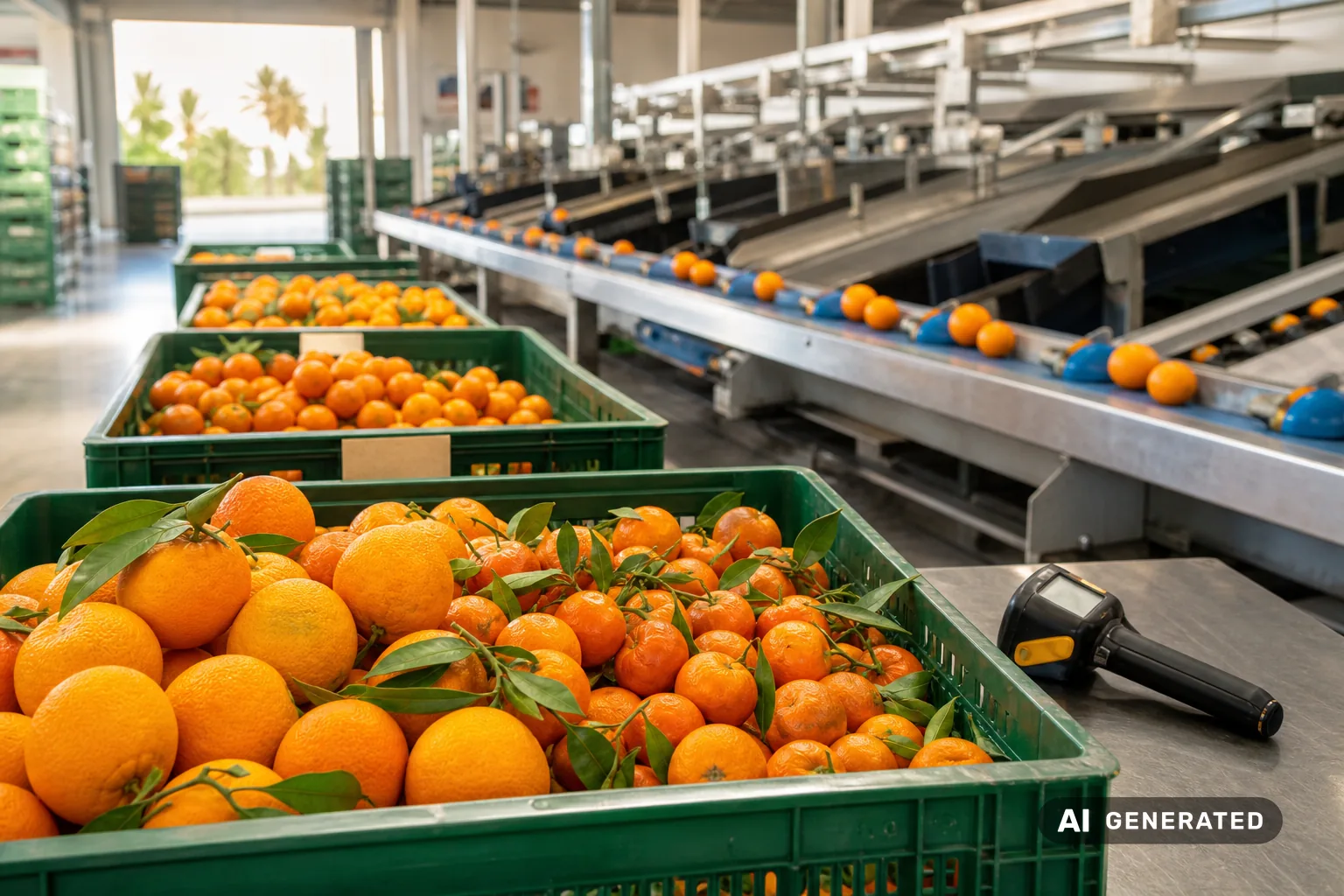
The quality of an orange or mandarin does not depend solely on its appearance. For each batch to reach its destination with reliable information, its identity must be preserved during reception, sorting, conditioning and dispatch. This tracking is known as citrus traceability and is part of the daily work of a citrus cooperative.
The Spanish Agency for Food Safety and Nutrition (AESAN) defines traceability as the ability to find and follow the trail of a food through the stages of production, processing and distribution. In practice, it means linking each consignment to its origin, the processes it has undergone and its destination.
What does citrus traceability mean?
Traceability is an identification and record-keeping system. Its purpose is not to fill in forms, but to answer specific questions quickly: which farm a consignment came from, when it was received, which checks were carried out, how it was prepared and which customer or destination it was sent to.
European food law establishes the principle of being able to identify the immediate supplier and the immediate customer. AESAN summarises this as “one step back and one step forward”. Within a citrus packing facility, internal traceability must also connect incoming fruit with the different processing stages and the final batch.
Backward, internal and forward traceability
- Backward: identifies the origin of the fruit received and the documentation associated with the consignment.
- Internal: links that intake to sorting, conditioning, packing and batch identification.
- Forward: shows the destination of each shipment and the information that accompanies it.
These three perspectives form a continuous journey. If one of them is lost, reconstructing the complete history of the product becomes much more difficult.
From the field to the cooperative: where records begin
Tracking begins before the fruit enters the facility. The farm, plot, variety and harvest date distinguish one consignment from another. When the citrus fruit arrives at the cooperative, reception confirms that identity and links it to an intake record.
At this point, the weight, condition of the load and checks defined by each organisation's working system may also be recorded. The important point is that the information accompanies the fruit from the outset and does not depend solely on people's memory.
Sorting, conditioning and batch formation
Once received, oranges and mandarins go through different operations according to their variety, condition and commercial destination. Grading groups the fruit according to defined criteria; conditioning, sorting and packing may then follow.
Internal traceability connects these operations to the origin record. When consignments are combined or separated, the system must preserve the link between the incoming fruit and the resulting batches. This prevents information from being lost during the process.
Cocalni markets different varieties and formats for much of the year. Its harvest calendar and product catalogue show the range of mandarins and oranges handled by the cooperative.
What information usually accompanies a batch?
Although the details depend on the product, customer and system in place, a batch may be linked to information such as:
- origin and identification of the consignment;
- variety and reception date;
- checks and operations carried out;
- packaging format and quantity;
- preparation or dispatch date;
- destination of the goods.
The batch code links the product to these records. It does not replace the documentation system, but it makes it possible to locate the required information without reviewing all the facility's activity.
Why is it important for customers and consumers?
Well-organised traceability makes it possible to determine quickly which product is affected if an incident arises. It also helps verify movements, answer queries and prevent a review from extending to consignments unrelated to the detected issue.
For professional customers, consistent batch information supports coordination with their own reception and distribution systems. For consumers, it contributes to a more transparent and responsive food chain.
Traceability alone does not guarantee every quality characteristic of a fruit. It is a control tool that must be integrated with hygiene, food safety, product inspection and continuous improvement procedures.
The role of a citrus cooperative
A cooperative brings together production from different farms and prepares it for different markets and formats. This coordination makes shared identification, reception and recording criteria especially important.
Besides organising the fruit's journey, the cooperative model supports members, adapts planning to each season and responds collectively to commercial requirements. At Cocalni, this work is carried out from its facilities in Les Alqueries and Vila-real, as part of a long-standing connection with citrus growing in Castellón.
The Our commitment page presents Cocalni's work on modernisation, production and certifications. Traceability is best understood within this broader framework of control and process development.
A chain of information that travels with the fruit
From identification at origin to the departure of a shipment, traceability connects people, records and operations. Its value becomes clear when information can be retrieved clearly, quickly and consistently.
In a citrus cooperative, this system helps preserve the identity of oranges and mandarins as they move from the field to the facility and from the facility to different destinations. Consumers rarely see this work, but it is essential for managing each season in an orderly and responsible way.
Are you looking for information about Cocalni's citrus fruit, formats or commercial calendar? Contact our team and tell us what you need.


