
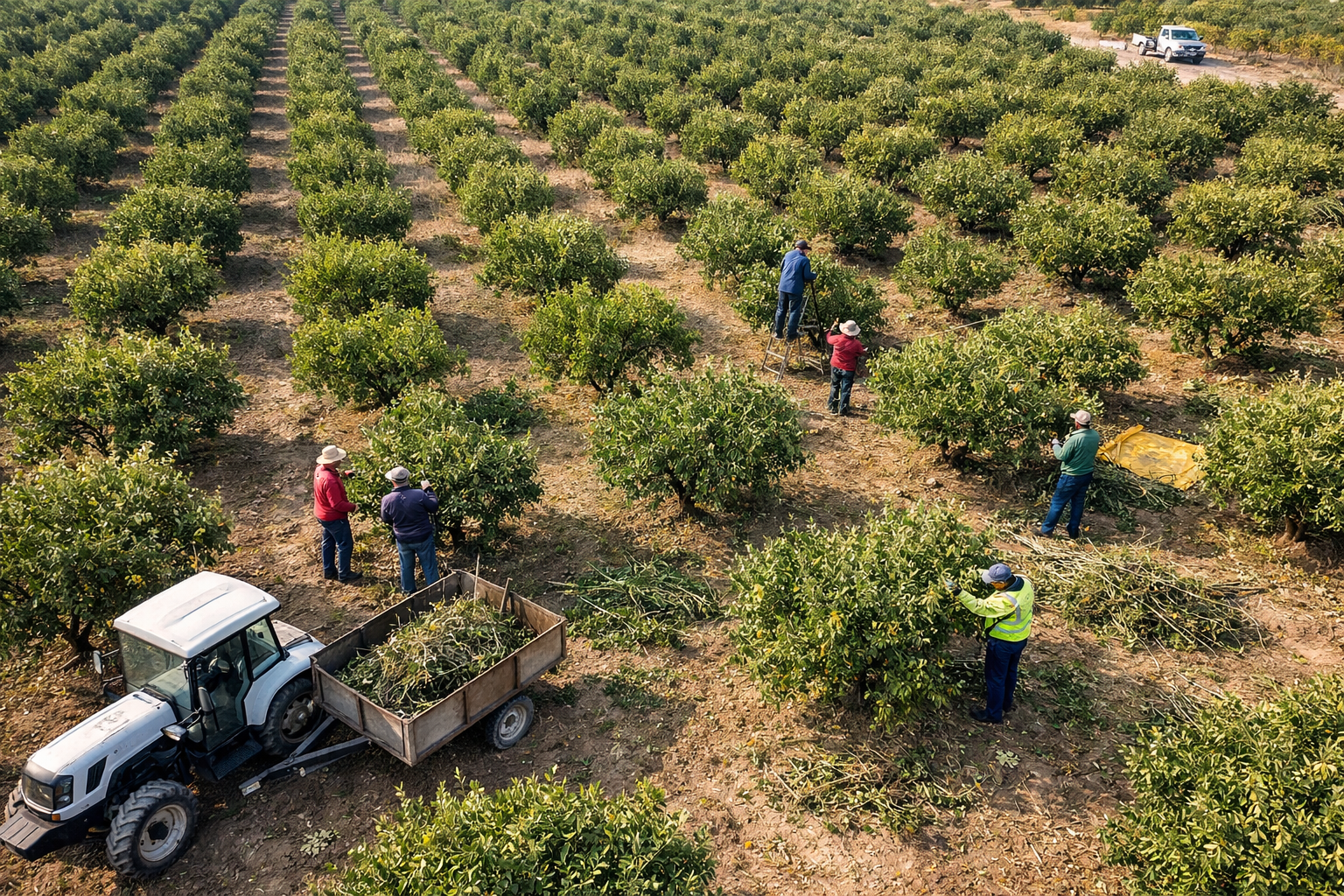
The citrus harvest sets the pace of work on many farms in the Valencian Community. However, when the harvest is over—or when most of the varieties have already been picked—work in the fields does not stop.
In fact, on many farms there are still late varieties to be harvested while farmers are already starting to think about the next season. It is a key time to check the condition of the plots, plan work, and prepare the trees for the next production cycle.
In this article, we review what is happening in the field during this transition phase and why these months are crucial for the future of production.
The end of the campaign does not mean stopping
Although we tend to talk about the “end of the season,” the reality in the field is more gradual. Some late varieties are still on the tree, while other plots have already finished harvesting.
This means that for several weeks, different situations coexist on farms: plots that have already been harvested, others awaiting harvest, and farmers who are beginning to prepare the land for the next cycle.
This stage allows you to calmly observe how each plot has responded during the season and make decisions to improve future production.
Campaign evaluation
One of the first steps after harvesting is to analyze how the season has gone.
The farmer observes various factors:
• Yield obtained • Fruit size and quality • Performance of varieties • Any phytosanitary problems that may have arisen • Tree response to treatments or fertilizers
This evaluation is very important because it allows us to adjust decisions for the next campaign.
Tree pruning and maintenance
On many farms, once the harvest of certain varieties is complete, pruning begins.
Pruning helps to:
• Balance tree growth • Improve light penetration • Promote ventilation • Prepare the tree for the next flowering season
Each plot and each variety requires different management, so this task is carried out progressively and in a planned manner.
Tree nutrition and recovery
After a productive season, the tree needs to recover its energy.
During this period, fertilizers are applied to strengthen the plant structure, improve soil condition, and prepare for future sprouting.
Proper nutrition management is key to ensuring good flowering and fruit set in the following season.
Phytosanitary control and prevention
Another fundamental aspect in this phase is phytosanitary surveillance.
The farmer and technicians check the condition of the plots to detect possible pests or diseases and take preventive action.
Prevention is especially important in citrus cultivation, as preventing the spread of pests protects not only a single plot, but the entire agricultural environment.
Planning for the next campaign
Perhaps one of the most important tasks at this stage is planning.
The farmer analyzes how the plot has performed, what improvements can be made, and what strategic decisions need to be made for the future.
Among them are:
• Adjustments to irrigation management • Changes to fertilization strategy • Varietal renewal or conversion • Improvement of agronomic practices
The role of cooperatives
Cooperatives play a fundamental role in this period of analysis and planning.
In addition to marketing the product, they offer technical advice, plot monitoring, and decision-making support.
This support enables farmers to adapt to market demands, improve the profitability of their farms, and work with greater guarantees.
Consumers tend to associate the citrus campaign with fruit harvesting, but behind every orange or tangerine there is continuous work throughout the year.
When one part of the campaign ends, the farmer is already working on the next one.
Because in the countryside, time never stands still: every decision made today influences the quality of the next harvest.


